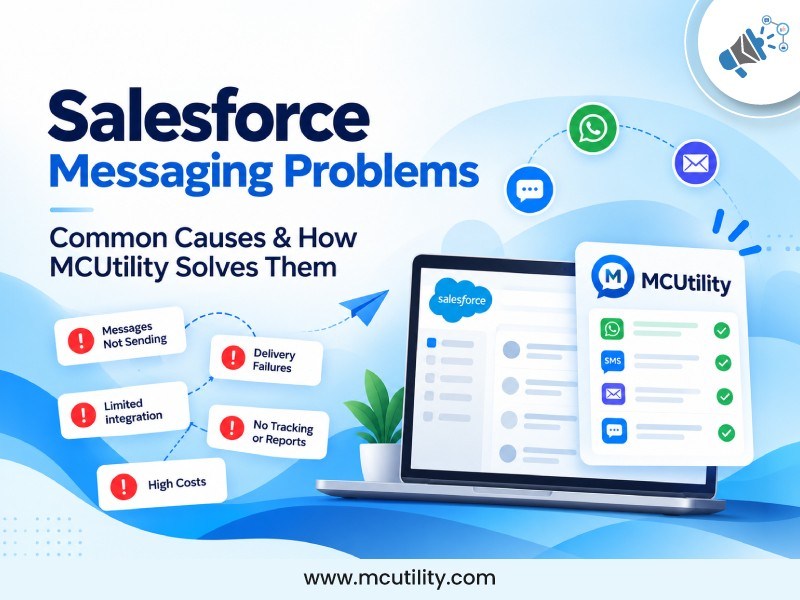
Effective customer communication requires more than sending messages at scale. Businesses need to ensure that every interaction is timely, relevant, and aligned with customer expectations. For organizations using Salesforce, managing high-volume communication, coordinating follow-ups, and maintaining personalized engagement across customer segments can become increasingly complex.
When messaging strategies lack proper targeting, personalization, or workflow alignment, even well-planned campaigns may fail to generate meaningful engagement. Delayed responses, irrelevant messages, and limited visibility into campaign performance can further affect communication outcomes.
This is where an effective Salesforce messaging app becomes valuable. MCUtility helps businesses streamline their Salesforce SMS messaging and Salesforce bulk messaging activities, supporting a more organized approach to customer outreach.
By simplifying messaging management, businesses can improve communication consistency, make better use of customer data, and build a stronger foundation for customer engagement at scale.
Table of Contents
- Why Does Salesforce Messaging Fail?
- How MCUtility Helps Improve Salesforce Messaging
- Best Practices for Better Salesforce SMS Messaging
- Conclusion
Why Does Salesforce Messaging Fail?
Salesforce messaging can help businesses connect with customers, nurture leads, and manage follow-ups. However, sending messages at scale does not always translate into meaningful engagement. Several challenges can affect the performance of Salesforce messaging campaigns.
- Generic Messages That Lack Personalization
Customers are less likely to engage with messages that feel irrelevant to their needs. Sending identical messages to every contact can make communication less effective, particularly when businesses serve different customer segments.
Use relevant customer data to personalize messages based on customer interests, previous interactions, preferences, and lifecycle stages. A well-planned Salesforce messaging app strategy can help businesses make communication more relevant.
- Poor Timing and Delayed Follow-Ups
Timing plays an important role in customer communication. A delayed sales follow-up, a missed appointment reminder, or an offer received after its expiry can reduce the value of a message.
Manual processes can make it difficult for sales and marketing teams to maintain consistent communication across large contact lists.
Establish clear messaging workflows for reminders, lead follow-ups, order updates, and other customer interactions. Where supported, automation can help teams communicate at the right stage of the customer journey.
- Ineffective Salesforce Bulk Messaging
Salesforce bulk messaging allows businesses to reach multiple contacts efficiently. However, sending the same message to a large audience without proper segmentation can lead to irrelevant communication and lower engagement. Outdated phone numbers, duplicate records, and poor contact data can also affect campaign quality.
Segment contacts according to relevant criteria, maintain accurate customer records, and tailor messages to each audience. Always follow applicable messaging regulations, consent requirements, and opt-out preferences.
- Disconnected Messaging Workflows
When messaging activities operate separately from Salesforce records, teams may struggle to maintain a consistent view of customer interactions. This can lead to repeated messages, missed follow-ups, and additional manual work.
Choose a messaging solution that aligns with your Salesforce environment and business processes. Connecting messaging activities with relevant customer records can help teams manage communication more efficiently.
- Limited Visibility into Campaign Performance
Sending a message is only one part of a successful campaign. Without reviewing delivery status, customer responses, and conversions, businesses may find it difficult to identify communication gaps.
Monitor available messaging metrics and evaluate campaign outcomes. Use these insights to refine message content, audience selection, and timing.
- Unclear Messages and Weak Calls to Action
Long messages, unclear wording, and missing next steps can make it difficult for customers to understand what they should do.
Keep messages concise, communicate one primary idea, and include a clear call to action. Whether the goal is to confirm an appointment, respond to a sales representative, or complete a purchase, make the next step easy to understand.
How MCUtility Helps Improve Salesforce Messaging
MCUtility provides a Salesforce messaging solution that can help businesses organize customer communication and manage messaging activities more effectively. Rather than relying on disconnected processes, businesses can explore a more structured approach to Salesforce SMS messaging.
Key areas where MCUtility can support messaging workflows include:
- Simplified messaging management: Manage messaging activities through a solution designed for Salesforce-based communication.
- More organized bulk outreach: Structure large-scale messaging campaigns around relevant customer groups and communication goals.
- Personalized customer communication: Use appropriate customer information to make messages more relevant to their intended audience.
- Consistent follow-ups: Support customer reminders and follow-up processes through suitable messaging workflows.
- Improved campaign evaluation: Review available reporting and messaging data to identify opportunities for improvement.
For organizations looking to improve their Salesforce SMS messaging processes, MCUtility offers an option to explore more organized communication within the Salesforce ecosystem.
Note: Confirm the specific features available in your MCUtility edition before making claims about automated workflows, personalization, reporting, or delivery tracking.
Best Practices for Better Salesforce SMS Messaging
To improve messaging effectiveness, businesses should focus on the following practices, alongside a suitable Salesforce messaging app can help businesses establish more consistent and customer-focused messaging processes.
84% of consumers surveyed had opted in to receive business SMS messages in 2025. SimpleTexting reported this finding from a survey of 1,000 US consumers.
- Know your audience: Understand customer needs and divide contacts into relevant segments.
- Personalize communication: Use accurate customer information to make messages useful and context specific.
- Choose the right timing: Align messages with customer actions, business events, and relevant communication windows.
- Keep messages concise: Use simple language, clear instructions, and one primary call to action.
- Respect customer preferences: Obtain the required consent and provide appropriate opt-out options.
- Measure campaign performance: Review delivery, responses, and conversions where tracking is available. Use the findings to improve future campaigns.
Conclusion
Salesforce messaging works best when communication is timely, relevant, and easy to manage. Generic texts, poorly targeted bulk campaigns, delayed follow-ups, and disconnected workflows can prevent businesses from getting the most out of their messaging efforts.
MCUtility offers businesses a way to approach Salesforce bulk messaging and Salesforce SMS messaging more strategically. By improving how messaging activities are organized and managed, businesses can work toward stronger customer engagement and more consistent communication. Ready to improve your Salesforce messaging strategy? Explore MCUtility and discover a smarter way to manage customer communication.
Frequently Asked Questions (FAQs)
Why does Salesforce messaging fail?
Common reasons include generic messages, poor timing, untargeted campaigns, disconnected workflows, and limited performance tracking.
What is a Salesforce messaging app?
A Salesforce messaging app helps businesses manage customer communication through Salesforce, depending on the features supported by the solution.
How can businesses improve Salesforce bulk messaging?
Segment contact lists, personalize content, verify contact data, respect consent and opt-out requests, and monitor campaign performance.
How does MCUtility help with Salesforce SMS messaging?
MCUtility helps businesses streamline their messaging approach. Confirm the specific automation, reporting, and personalization features available in your MCUtility edition before publishing detailed product claims.
What makes Salesforce SMS messaging more effective?
Relevant content, appropriate timing, clear calls to action, audience targeting, and regular performance reviews can help improve campaign effectiveness.

